Is Your Life Worthy of Imitation?
Supporting Scripture: 1 Peter 1:15–16; Romans 7:22–25; Philippians 3:12–17; 1 John 1:8–9; John 14:15
Men, before we begin, a brief reminder about those little chapter and verse numbers in our Bibles. First Corinthians was written as a letter, not a book divided into chapters and numbered verses. Those divisions, added centuries later, can sometimes interrupt an argument Paul intended his readers to follow continuously. I've written more about this here: Those Little Numbers in Your Bible.
Our focus verse, 1 Corinthians 11:1, is a perfect example. Although our Bibles place it at the beginning of chapter 11, it belongs logically and rhetorically with Paul's concluding argument in chapter 10. Separating it from the preceding discussion risks obscuring what Paul is actually asking the Corinthians to imitate.
Imitate Me
Throughout chapters 8–10, Paul addresses a controversy involving food offered to idols, Christian freedom, conscience, and the responsibilities believers have toward one another. Some Corinthians understood that an idol was nothing and that food itself did not bring them nearer to God. But Paul insisted that possessing correct knowledge did not excuse conduct that harmed a brother's conscience. Knowledge could make a man arrogant, while love required him to consider the welfare of others.
Paul then pointed to his own conduct. Although he possessed legitimate rights as an apostle, he willingly surrendered some of those rights rather than hinder the gospel. He used the example of an athlete who disciplines himself, warned the Corinthians through Israel's history against presumption and idolatry, and concluded by directing them to do everything for God's glory while seeking the good of others.
Immediately before our focus verse, Paul writes that he seeks the advantage of others rather than his own, so that they may be saved (10:33). Then comes his conclusion: “Be imitators of me, as I am of Christ.”
Paul is not presenting himself as a sinless man. He is telling the Corinthians that they can look at the way he exercises freedom, sacrifices personal advantage, disciplines himself, and seeks the good of others, and see something of the character of Jesus Christ.
Now, men, here is the question I want us to consider today, both rhetorically and quite literally:
Is your life worthy of imitation?
Could you say those words to your wife? To your sons and daughters? To your grandchildren? To your male friends and female acquaintances? To the people in your community who observe how you conduct yourself?
Could you look another man in the eye and say, without hypocrisy, “Imitate me, as I imitate Christ”?
Or do we read Paul's words and quietly excuse ourselves by concluding, Well, that was Paul. He was an apostle. I'm certainly not.
But is that really a legitimate conclusion? Paul tells the Philippians to join in imitating him and to observe others who walk according to the example they have received (Philippians 3:17). The expectation was never that only apostles would become examples worth following. Mature disciples were to become visible examples of the life Christ commands.
That should trouble us, particularly those of us who have professed to follow Jesus for many years.
The Pursuit of Holiness
In 1979, just a couple of years after I became a Christian, I read Jerry Bridges' book The Pursuit of Holiness. That little book became instrumental in my development as a follower of Jesus, and one illustration in particular helped me understand something I had been struggling to comprehend.
God commands His people, “Be holy, for I am holy” (1 Peter 1:16). I understood the command. I wanted to obey it. But the more seriously I pursued holiness, the more aware I became of how far short of God's holiness I actually fell.
How could I be pursuing holiness and yet becoming increasingly conscious of my sinfulness?
Bridges illustrated this with a simple graph.
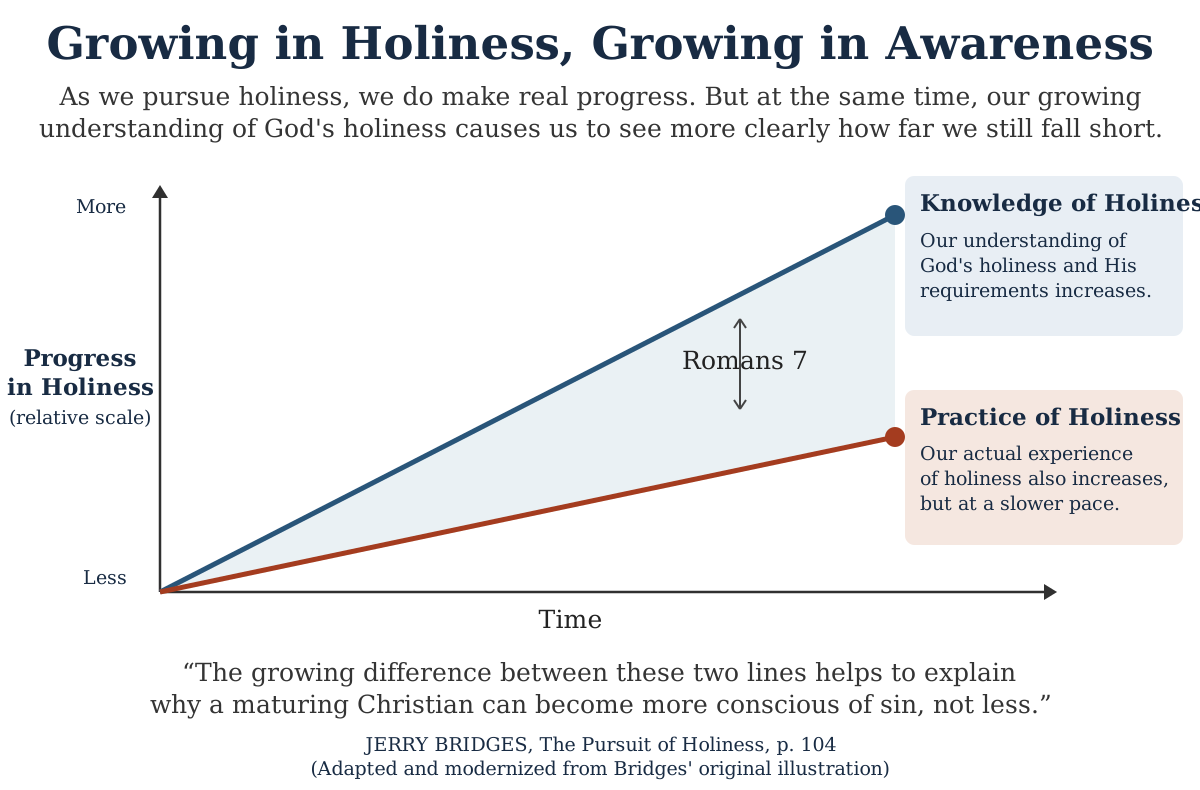
The graph begins with two upward-moving lines over time. One represents our growing knowledge of God's holiness; the other represents our growing practice of holiness. Both rise, but our understanding of God's holiness grows more rapidly, leaving an increasingly visible gap between what we understand and what we actually practice.
The graph identifies that gap with Romans 7.
That illustration helped me tremendously. The more I came to understand the holiness of God, the more I recognized sins I had previously overlooked, tolerated, excused, or perhaps never even considered sinful.
I was learning to measure my life against God's holiness rather than against the conduct of other men.
And that changes everything.
Holiness Is Not a Western Success Model
Here is where I believe many Western Christian men misunderstand the pursuit of holiness. We have been conditioned to think of almost everything in terms of measurable success. We set goals, establish benchmarks, monitor progress, and expect eventually to arrive at some recognizable level of achievement.
It is tempting to approach holiness in precisely the same way. Read enough Scripture, pray consistently, eliminate a few bad habits, develop some good ones, and eventually become a successful Christian.
But holiness is not another achievement to add to our résumé.
The Law reveals God's righteousness and exposes our sin. It demonstrates why we need a Savior. And as we grow in our knowledge of God's character, we discover that sin is not limited to the obvious transgressions we learned to avoid when we first believed. It reaches into our motives, ambitions, pride, selfishness, impatience, resentments, words, and even the reasons we do apparently good things.
This does not mean obedience is futile. Bridges was emphatic that we must actually pursue holiness through obedience, discipline, and dependence upon the Holy Spirit. But it does mean that our progress cannot be reduced to congratulating ourselves over how much better we have become.
Indeed, one of the evidences of spiritual maturity may be that we become increasingly unwilling to congratulate ourselves at all.
The more clearly we see God's holiness, the more astonishing His mercy becomes. The more honestly we recognize our sin, the more precious Jesus Christ becomes to us. And the more deeply we understand what His death on the Cross accomplished, the more our obedience becomes a response of love rather than an attempt to establish our own righteousness.
The pursuit of holiness should not make us increasingly impressed with ourselves. It should make us increasingly overwhelmed by the grace of God in Jesus Christ.
Repentance Is the Practice of Godly Men
This is why I speak so frequently about repentance.
Men, I sin a lot. And so do you.
Perhaps that statement sounds unnecessarily severe. But I suspect our reaction depends largely upon how we have learned to measure sin.
If we measure ourselves primarily by the sins we no longer commit, we may conclude that we are doing rather well. If we compare ourselves with the behavior of unbelievers or even less mature Christians, we may feel quite satisfied with our spiritual progress.
But if we measure ourselves against the holiness of God, including the commands of Jesus concerning our hearts, our words, our relationships, and our motives, the picture changes dramatically.
Have I loved God today with all my heart, soul, mind, and strength? Have I loved my neighbor as myself? Have I loved my wife as Christ loved the church? Have I been entirely truthful, patient, humble, generous, merciful, and free from selfish ambition? Have I sought the good of others when doing so required surrendering something I wanted?
And what about the things I should have done but neglected?
John warns us that if we claim to have no sin, we deceive ourselves (1 John 1:8). He immediately reminds believers that when we confess our sins, God is faithful and just to forgive and cleanse us (1 John 1:9).
Repentance, then, is not merely something a man did when he first became a Christian. It is part of the continuing life of a man who follows Jesus, recognizes his sin, confesses it, turns from it, and learns to obey his Lord more faithfully.
And that brings us back to Paul's remarkable invitation.
A man worthy of imitation is not a man who never sins. He is a man whose life increasingly demonstrates obedience to Christ, love for others, humility when confronted, and genuine repentance when he fails.
Our wives and children should not have to imagine what repentance looks like. They should have witnessed it in us. Our brothers should not have to wonder whether we are willing to confess our sins. They should know we are.
Can those who know us best see a man who is genuinely following Jesus Christ?
A Response of Love
Men, today I want to ask you to make two commitments.
First, commit yourself before God to becoming a man whose life is worthy of imitation. Not because you expect to achieve perfection, but because you intend to follow Jesus seriously enough that others can see His character being formed in you. Let your wife, your children, your friends, and your brothers see obedience, self-denial, humility, confession, and repentance, not merely hear you talk about them.
Second, purchase Jerry Bridges' The Pursuit of Holiness and commit to actually reading it. I first read it in 1979, and I believe its treatment of God's holiness, our responsibility to obey, and our ongoing struggle with sin can be as valuable to you as it was to me.
Book: The Pursuit of Holiness, Jerry Bridges (NavPress/Tyndale)
If you are willing to make both commitments, click “Share with the Men” under I Took This Step and tell your brothers that you intend to do so. Let us encourage one another, hold one another accountable, and learn together what it means to live lives that point others toward Christ.
I took this step today: ☐
The Source
Men, the Christian life does not begin with our ability to imitate Christ. It begins with the grace of God, Who loved us while we were still sinners and sent His Son to reconcile us to Himself.
Jesus Christ is not merely the perfect example we are commanded to follow. He is our Savior, Who bore our sins on the Cross and through Whom we receive forgiveness, reconciliation, and new life. Without Him, the command to be holy would only expose our condemnation. Through Him, we are forgiven and called to walk in the obedience of faith, empowered by the Holy Spirit.
Paul himself understood that he had not arrived. In Philippians 3:12, he acknowledged that he had not already obtained perfection, but continued pressing on because Christ Jesus had made him His own.
That is the kind of man I want to be. After nearly fifty years of following Jesus, I am still learning how much I need His mercy, how much sin remains to be confronted, and how much I have yet to learn about loving Him through obedience.
And that is the kind of man I hope each of you will become: not a man who imagines he has arrived, but one who can say to those who know him, “Follow me as I follow Christ.”
Not because we have become impressive men, but because Jesus Christ has become increasingly preeminent in our lives.
Behold Christ · Repent · Obey in Love
I Took This Step
Your response stays on this device unless you deliberately choose to send it.
Ask a Question
A question about the passage, the historical context, the application, or the step you are trying to take.